

Often dubbed “the silent killer,” driver fatigue is a common pitfall on mining sites across the globe. In one case, an articulated dump truck (ADT) operator fell asleep en route to offload. *
The operator survived. The ADT and safety infrastructure fared worse. And the aftermath triggered a full-scale legal investigation - one that could have been avoided with earlier detection and real-time oversight.
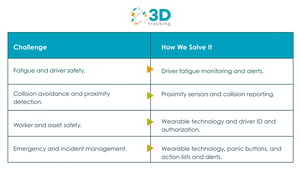
That’s where fleet telematics for mining comes in. By equipping your clients with the tools to see more, monitor smarter, and respond faster, you give them the opportunity to prevent devastating (and expensive) incidents before they occur.
How Telematics Improves Fatigue Detection and Response
A report from Caterpillar Global Mining attributed 65% of mining haul truck accidents to operator fatigue. The same report revealed that drowsy or sleep-deprived truck drivers were responsible for 91,000 crashes and 800 deaths. **
This risk is amplified when mining operators work long shifts in extreme environments, often in isolated locations.
However, the 3Dtracking platform goes far beyond basic location tracking. By integrating advanced driver monitoring technologies and health tracking tools, you can provide your clients with a complete safety solution, one that not only spots danger but also empowers them to act on it.
Here’s how:
Driver monitoring
The platform’s live tracking functionality gives mining fleet owners a central location to monitor an extensive list of data points; location, speed, sensor data and much more are at their fingertips, so if a weary driver exceeds the speed limit or drifts off course, then the control center will know about it.
Fatigue monitoring with smart cameras
Our platform’s integration with industry-leading hardware from providers like Jimi IoT, Streamax and Queclink allows fleet managers to monitor their operators' behavior in the moment.
3Dtracking’s software supports a wide range of cameras, most recently including the Jimi JM - LL01 and Queclink’s GV501LG. These cameras use AI to detect signs of drowsiness, such as blinking frequency, yawning, head nodding, and eye closure - if fatigue is detected, alerts are sent to supervisors or fleet managers to intervene.
Monitoring risky operator behavior
ADAS (Advanced Driver Assistance Systems) integrations help track and correct risky driving behavior. This could be anything from lane drifting and unsafe following distances to harsh braking, common symptoms of fatigue or poor visibility on mining routes.
This data gives your clients deeper insight into driver performance and can be used for both real-time alerts and post-incident training among drivers.
Emergency alerts
Give operators a quick, accessible way to report emergencies from inside the cab. One-touch panic buttons notify supervisors instantly, so help can be dispatched without delay.
Similarly, based on their exact configuration, devices can send alerts regarding crash events or other unusual and potentially dangerous vehicle activity.
Strict adherence to service intervals
The 3Dtracking platform promotes proactive maintenance for mining fleets with functionality that helps fleet owners schedule routine maintenance - for example, after a certain distance. This data removes the guesswork when fleet owners want to ensure their equipment is operating at peak performance.
Detect Collisions and Monitor Proximity to Prevent Onsite Accidents
In busy mining environments, heavy machinery operates in close quarters, and visibility is limited. Collision prevention quickly becomes a top priority; between just 2000 and 2007, collisions and driving over an unseen edge caused three to four fatalities per year in surface mining environments. ***
The good news is that with the right combination of live monitoring, sensors, and alerts, you can offer your clients the tools to actively detect risks and reduce accident rates across the site.
Key features of 3Dtracking’s telematics platform include:
- Live monitoring. The platform’s live tracking features give supervisors a centralized view to monitor all vehicle and personnel movement in real time. This allows for immediate response to proximity risks.
- 360° multi-camera systems. Support for front, rear, side, and in-cabin cameras provides full visibility around each vehicle. This comprehensive view helps operators detect nearby hazards, blind spots, and pedestrian activity.
- Proximity and collision sensors. External proximity sensors detect when vehicles or equipment come too close to fixed structures or other assets, triggering immediate alerts to control centers. These warnings help prevent low-speed but high-damage accidents.
- Speed monitoring and alerts. Real-time speed tracking allows supervisors to set site-specific speed limits. Automated alerts notify fleet managers when vehicles exceed limits – this helps them to enforce compliance and reduce reckless driving behavior.
- Incident detection and reporting. Fleet managers have everything they need to proactively flag sudden impacts, harsh braking, or abrupt vehicle movements, events which are often linked to near-misses or collisions.
Tighten Worker and Asset Safety
On a mining site, the margin for error is razor thin. The operation of heavy machinery requires constant concentration and absolute control, and any lapse, whether due to human error, environmental conditions, or equipment malfunction, can snowball into severe consequences.
As a fleet management service provider, you play a key role in helping your clients safeguard both their workforce and their assets. Through the 3Dtracking platform, you give them access to a range of advanced telematics features that work together to reinforce safety.
Here’s how fleet telematics in mining makes a positive difference:
- Location-based risk management. Using geofencing and live tracking, fleet managers can create safety zones and monitor drivers’ proximity to hazardous areas. If vehicles enter restricted zones, control centers will receive an alert.
- Air quality monitoring. High levels of carbon dioxide in confined or poorly ventilated areas pose a serious health risk to personnel. However, thanks to the sensors integrated into vehicles or site infrastructure, the 3Dtracking platform allows for continuous air quality monitoring. If dangerous levels are detected, alerts will be triggered.
- Real-time equipment monitoring. Our platform supports detailed tracking of high-risk machinery. This helps clients ensure that equipment is being operated safely, within approved zones, and only by authorized personnel.
- Input-based safety checks. User-defined inputs can be configured to monitor key safety indicators, such as seatbelts, door sensors, engine status, or operator presence.
- Incident reporting and alerts. When a safety breach or equipment-related incident occurs, automated alerts and time-stamped reports provide immediate context for response teams. No more guessing what happened or why.
Manage Emergencies and Incidents Easier and Faster
Remote locations, hazardous environments, and fast-moving operations can be a lethal combination. Delays in response not only increase risk exposure, but they complicate investigations and heighten liability.
Our 3Dtracking platform turns a delayed reaction into a coordinated response. Here’s how:
- Panic button alerts. Quick-response panic buttons empower drivers and mining personnel to raise the alarm instantly in the event of a crash, fire, medical emergency, or security threat.
- Customizable alerts and action lists. Each alert can be tied to a predefined action list. This makes sure that when an incident occurs, the correct response is automatically set in motion.
- Real-time video streaming. Live-streamed footage from in-cabin or external cameras gives fleet managers and safety supervisors the ability to assess incidents as they unfold.
- GPS-linked incident data. Every alert and video event is timestamped and geolocated, giving your clients a complete picture of what happened, where, and when.
FAQs About Fleet Telematics in Mining
Why is fleet management important in mining?
3Dtracking’s fleet management platform provides much-needed visibility and operational control in high-risk environments like mining. The platform’s live monitoring and pre-configured alerts can help fleet supervisors prevent accidents commonly caused by driver fatigue, poor visibility, or equipment failure.
How is AI transforming fleet management in mining?
With AI, you can receive real-time data on potential risks. 3Dtracking’s software integrates smoothly with smart devices that make it easy to identify drowsiness, risky behavior, and unsafe driving patterns.
How can telematics improve asset utilization and management?
Telematics provides live insights into vehicle usage, health, and location. Our platform’s utilization alerts and mileage limit alerts are just two examples of ways that mining operators can optimize equipment deployment, keep equipment in optimal operational condition, and reduce unplanned downtime.
Helping your clients tighten safety around both their people and machinery is a value-add that reinforces your role as a trusted service provider. The 3Dtracking platform makes it easier than you’d expect to get started.
Contact our team for a free demo and see how fleet telematics in mining can make the difference between life and death, cost and reward.
References
*National Highway Traffic Safety Administration. (n.d.) Drowsy driving. Retrieved July 10, 2025, from https://www.nhtsa.gov/risky-driving/drowsy-driving
**Caterpillar Global Mining. (2007). Viewpoint: Perspectives on modern mining.
***Centers for Disease Control and Prevention. (n.d.) Machinery-related struck-by injuries in mining. National Institute for Occupational Safety and Health (NIOSH). https://www.cdc.gov/niosh/mining/topics/machinery-struck-by-injuries.html